

Hair Growth vs Length Retention: They’re Not the Same Thing
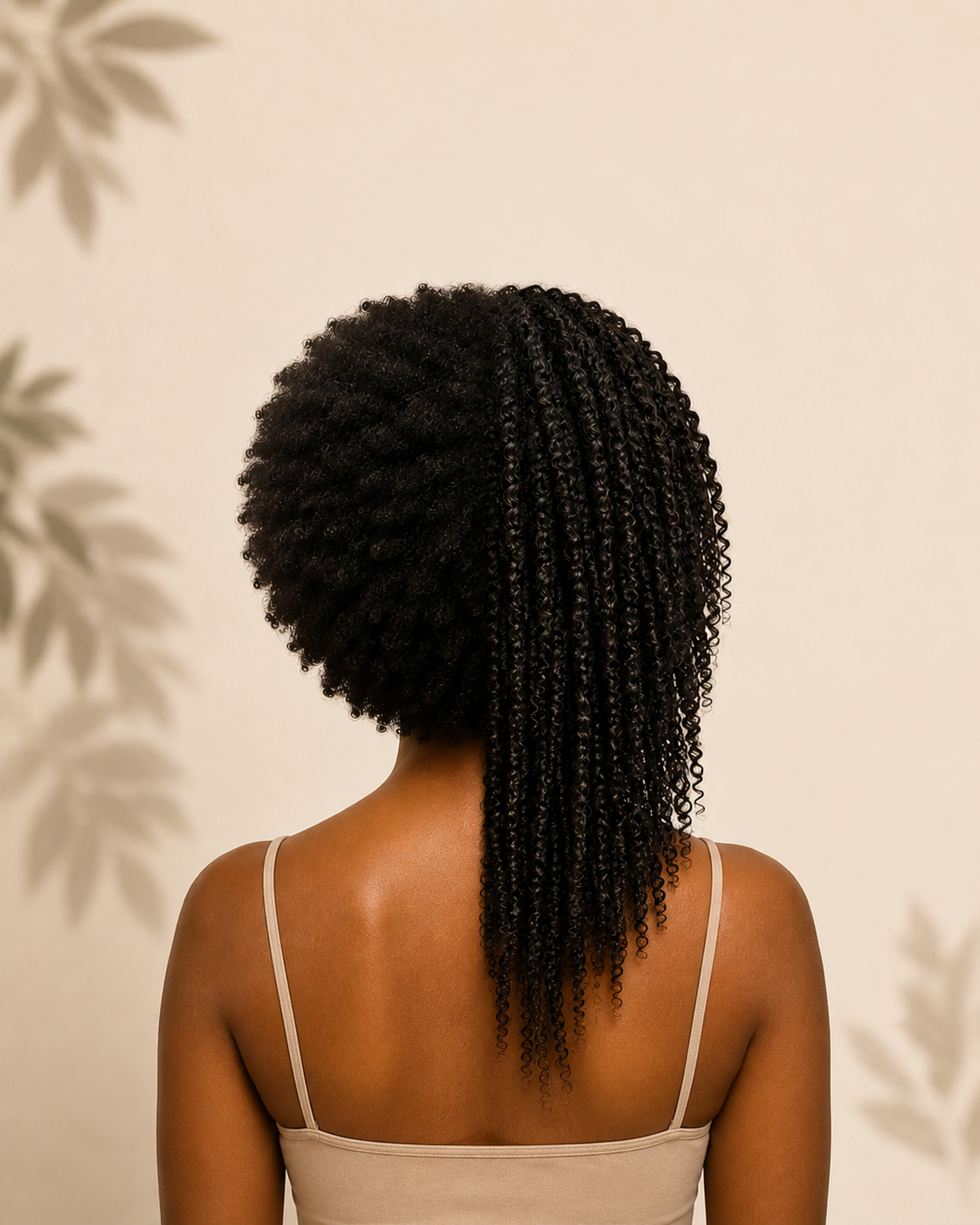
Your hair may be growing more than you think. The real question is: how much of that growth are you retaining?
Your hair may be growing perfectly well. The real question is: are you keeping what you grow?
If you've ever looked at your hair after months of trying to grow it and thought, “Why isn't my hair getting any longer?”, you may have assumed that your hair simply isn't growing.
But that isn't necessarily what's happening.
One of the most important things to understand about your hair journey is that hair growth and length retention are two different things.
Your hair can be growing from your scalp while simultaneously breaking further down the strand.
And when the amount you're losing through breakage is similar to the amount you're growing?
It can look as though your hair hasn't grown at all.
Let's break it down.
What Is Hair Growth?
Hair growth happens at the scalp.
Each strand of hair grows from a follicle within your skin and goes through its own natural growth cycle.
On average, scalp hair grows approximately 1 cm per month, although the actual rate varies from person to person. Genetics, age, hormones, nutrition, general health and the hair-growth cycle can all influence what you experience.
This means that when you're trying to support healthy hair growth, your scalp matters.
Keeping your scalp clean, maintaining a consistent wash routine and minimising practices that place unnecessary stress on your follicles can all form part of a healthy hair-care routine.
But here's where things get interesting.
You can have perfectly normal hair growth and still struggle to see an increase in your overall length.
Why?
Because growing the strand is only the first part of the process.
What Is Length Retention?
Length retention is exactly what it sounds like:
Keeping the length you've already grown.
Once your hair emerges from your scalp, the visible strand is no longer living tissue. It cannot heal itself when it becomes damaged in the same way your skin can.
And the longer your hair becomes, the older your ends are.
Think about that for a moment.
If your hair is several years old at the ends, those strands may have been through hundreds of wash days, detangling sessions, hairstyles, nights of sleeping, changes in weather, manipulation and potentially heat or chemical treatments.
That's why your ends often need the most protection.
Length retention therefore becomes less about making your hair grow and more about:
reducing unnecessary breakage.
The Hair-Growth Illusion
Imagine your hair grows roughly 1 cm this month.
Great.
But during that same period, weakened strands and ends are continually breaking.
You grew hair.
But you didn't retain all of that growth.
Now imagine that pattern continuing month after month.
You may eventually conclude:
“My hair just doesn't grow past this length.”
When the reality may be that your hair does grow beyond that point — it simply isn't retaining enough length for you to see the difference.
This is sometimes why people describe their hair as being “stuck” at a particular length.
The problem isn't necessarily happening at the root.
It could be happening much further down the strand.
So What Causes Poor Length Retention?
There isn't one universal cause.
Our hair routines are different, and breakage can result from several factors working together.
But some common contributors include:
💧 Insufficient moisture
Textured hair can be particularly prone to dryness because the natural oils produced by the scalp have a more difficult journey travelling along bends, curls and coils.
Hair that becomes excessively dry can become more vulnerable to breakage.
🪮 Excessive manipulation
Combing, brushing, detangling, styling, restyling and constantly handling your hair all create mechanical stress.
That doesn't mean you should never touch your hair.
It means how often and how you manipulate it matters.
🛡️ Poor protective practices
A hairstyle being called “protective” doesn't automatically make it protective.
If a style creates excessive tension, leaves vulnerable areas exposed, causes matting or requires aggressive manipulation during installation or removal, it may actually work against your retention goals.
🔥 Excessive heat
Frequent or improperly used heat can weaken the hair's structure and increase the likelihood of damage and breakage.
✂️ Damaged ends
Split, weathered or severely damaged ends don't magically repair themselves.
Products may temporarily improve how damaged hair feels or behaves, but once the strand is significantly compromised, sometimes trimming is part of protecting the healthier length above it.
Growth Happens at the Scalp. Retention Happens Along the Strand.
This is probably the simplest way to remember the difference.
GROW IT 🌱
Think scalp, follicles and supporting a healthy environment for hair growth.
RETAIN IT 📏
Think moisture, handling, protection and preserving the strands you've already grown.
And you need both if your goal is visibly longer, healthier-looking hair.
A fantastic scalp routine cannot completely compensate for hair that's continually snapping at the ends.
And protecting your ends cannot determine how quickly your follicles naturally produce hair.
They are two parts of the same journey.
What Should Your Routine Actually Look Like?
You don't need a 15-step routine.
In fact, complicated routines aren't automatically better.
A good routine should be something you can understand, maintain and adjust according to what your hair needs.
At its core, think about four areas:
Cleanse. Moisturise. Protect. Observe.
Cleanse your scalp and hair appropriately.
Replenish moisture and use products that help reduce dryness.
Handle your strands carefully and consider how your styling choices affect both your hair and scalp.
And perhaps most importantly:
pay attention to your own hair.
Are you experiencing more breakage?
Are your ends becoming increasingly thin?
Is your scalp uncomfortable?
Does a particular hairstyle repeatedly cause problems?
Are you actually retaining more length when you manipulate your hair less?
Your routine shouldn't simply be a collection of products.
It should be informed by what you're observing.
Where Hair We Gro Fits In
This distinction between growth and retention is also behind the way I think about Hair We Gro.
Our Stimulating Hair Oil is designed to complement your scalp and healthy hair-growth routine.
Our Moisturising Hair & Body Butter focuses on moisture and nourishment and can be used to help seal moisture into your hair — supporting the other side of the equation: length retention.
Together, the philosophy is simple:
🌱 Grow It.
📏 Retain It.
But no product can replace understanding your hair.
That's why Hair We Gro is increasingly about more than what you purchase and put onto your strands.
It's about hair education.
Understanding what you're doing.
Understanding why you're doing it.
And learning to recognise what your own hair is telling you.
Stop Asking Only: “How Do I Grow My Hair?”
Start asking:
How am I caring for the hair I've already grown?
Because sometimes the solution isn't another growth product.
Sometimes your hair has been growing all along.
Your routine simply hasn't been helping you keep it.
GROW IT. 🌱 RETAIN IT. 📏
Hair growth and length retention aren't the same thing.
And understanding the difference could completely change the way you approach your hair journey.
— Kiesha Arielle
Founder, Hair We Gro