

Dandruff vs Seborrheic Dermatitis: What's the Difference?
And where does dry scalp fit into all of this?
If you've ever looked down at your shoulders, spotted a few flakes and immediately thought, “My scalp must be dry,” you're definitely not alone.
Flaking is one of those scalp symptoms that can make several different conditions look remarkably similar.
Dry scalp can flake.
Dandruff can flake.
Seborrheic dermatitis can flake.
But that doesn't mean they're all the same thing.
In a previous Hair School lesson, we looked at the difference between dry scalp and seborrheic dermatitis. But there's another condition that belongs in this conversation: dandruff.
And this one gets particularly interesting because dandruff and seborrheic dermatitis are closely related.
So, let's get into it.
Dandruff and Seborrheic Dermatitis Are Closely Related
Dandruff and seborrheic dermatitis aren't necessarily considered two completely unrelated scalp conditions.
Dandruff is generally regarded as a milder, less inflammatory form of seborrheic dermatitis, with both existing along the same disease spectrum.
Both are associated with factors including sebum, Malassezia yeast and the way our skin responds to them.
Malassezia itself isn't automatically a problem.
It's a type of yeast that naturally lives on human skin, particularly in areas where there is more sebum.
So simply having Malassezia on your scalp doesn't mean something is wrong.
The difference appears to lie partly in how an individual's skin responds to its presence and activity, alongside other factors affecting the scalp environment.
And that's where dandruff and more pronounced seborrheic dermatitis can begin to look different.
What Does Dandruff Look Like?
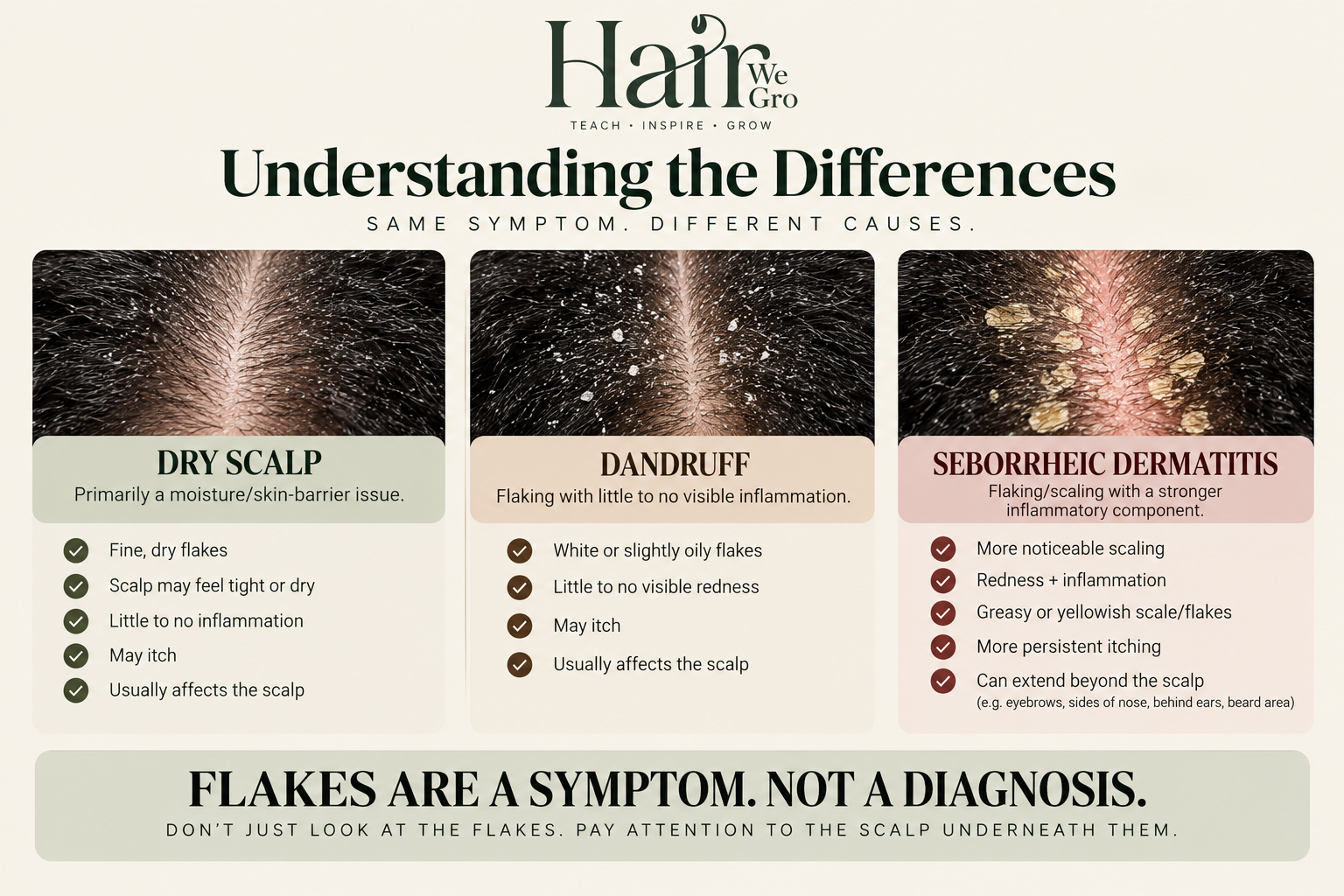
Dandruff primarily affects the scalp and is generally characterised by visible flaking with little to no obvious inflammation.
You might notice:
White or slightly oily flakes
Flakes appearing throughout the scalp or on clothing
Some itching
Little to no visible redness or inflammation
The scalp underneath the flakes may otherwise look relatively normal.
This is an important distinction because people often assume that flakes automatically mean their scalp lacks moisture.
They don't.
Flaking is a symptom — not a diagnosis.
What Does Seborrheic Dermatitis Look Like?
Seborrheic dermatitis tends to involve a stronger inflammatory component.
Alongside flaking or scaling, you may experience:
More noticeable scaling
Redness or visible inflammation
Greasy or yellowish scales/flakes
More persistent itching
Irritated areas of skin
And unlike dandruff, seborrheic dermatitis isn't necessarily confined to the scalp.
It can also occur in other areas where sebaceous glands are particularly active, including the:
Eyebrows
Sides of the nose
Behind the ears
Beard or moustache area
Upper chest
Not everyone with seborrheic dermatitis will experience every one of these symptoms, and severity can vary considerably.
So Where Does Dry Scalp Fit In?
This is where things can get confusing.
A dry scalp can ALSO produce flakes and itching.
But the underlying problem is different.
Dry scalp is primarily associated with dryness and disruption of the skin barrier, rather than being the same condition as dandruff or seborrheic dermatitis.
Someone experiencing dry scalp may notice small flakes alongside sensations such as tightness or dryness.
So although all three can potentially involve flaking, a useful way of understanding them is:
DRY SCALP
Primarily a moisture/skin-barrier issue.
DANDRUFF
Flaking with little to no visible inflammation.
SEBORRHEIC DERMATITIS
Flaking or scaling with a stronger inflammatory component.
And that brings us to perhaps the most important takeaway from this entire conversation:
Flakes Are a Symptom. Not a Diagnosis.
Seeing flakes tells you that something is happening on your scalp.
It doesn't necessarily tell you what.
Rather than looking only at the flakes themselves, look at the scalp underneath them.
Is there redness?
Is the scalp visibly inflamed?
Do the flakes appear dry, oily or yellowish?
Is the itching persistent?
Are similar symptoms appearing around your eyebrows, ears or other areas of your face?
How quickly do the symptoms return?
Those additional clues can give you a much better picture of what may be happening than the presence of flakes alone.
That doesn't mean you need to diagnose yourself, either.
If you're experiencing persistent, severe or worsening scalp symptoms — particularly significant inflammation, soreness, crusting, bleeding or hair loss — it's worth speaking to a GP or dermatologist who can assess your scalp properly.
And This Made Me Reconsider My Own Scalp
This lesson also caused me to reflect on something I've previously shared with the Hair We Gro community.
I had described my own scalp experience as seborrheic dermatitis.
But after looking more closely at the distinction between dandruff and more pronounced seborrheic dermatitis, I realised that dandruff — or very mild seborrheic dermatitis — may have been a more precise description of what I was experiencing.
I experienced flaking and some itching, but I wasn't seeing the significant redness, inflammation or greasy yellow scaling commonly associated with more pronounced seborrheic dermatitis.
Does that mean everything I previously understood about my scalp was suddenly wrong?
No.
It means I've learned something that allows me to describe that experience with more nuance.
And that's exactly what Hair School is supposed to be about.
We're not just collecting hair tips.
We're learning how our hair and scalp actually behave — and sometimes learning means being willing to refine what we previously thought we knew.
The Hair School Takeaway
Remember these three things:
Dry scalp isn't automatically dandruff.
Dandruff isn't simply another name for dry scalp.
Dandruff and seborrheic dermatitis are closely related, with dandruff generally representing the milder, less inflammatory end of the spectrum.
So the next time you notice flakes, don't just look at the flakes.
Pay attention to the scalp underneath them.
Healthy hair starts with understanding the scalp it's growing from.
— Professor Kiesha 🎓
Hair We Gro | Teach • Inspire • Grow